
The first request for a steel shipment from Luojing is often short:
Steel coils. Shanghai to [destination]. Please quote.
That is enough to start a conversation. It is not enough to fix a loading plan.
Before we discuss the vessel, we want the cargo list at piece level. The reason is practical: a coil, a pipe bundle and a section bundle may all be called steel, but they do not use the same supports, lifting points or securing method.
The minimum data is per piece, not only total tonnage
For the first working check, we need this information:
| Field | What must be shown |
|---|---|
| Cargo type | Coil, pipe, plate, section or mixed steel |
| Quantity | Number of pieces or bundles |
| Weight | Gross weight of every piece; total tonnage separately |
| Dimensions | Maximum length × width × height per piece |
| Coil details | Outside diameter, inside diameter, width and eye direction |
| Packing | Bare, strapped, palletised, wrapped or boxed |
| Handling | Lifting points, COG if available, crane or forklift requirement |
| Timing | Cargo-ready date and acceptable loading window |
| Route | Luojing loading point, destination port and any discharge limit |
The total tonnage is useful for a budget. It does not tell the terminal or vessel team whether the heaviest coil can be lifted, whether a bundle can be supported, or whether the pieces can be placed in the intended sequence.
One photo can expose a missing number
The warehouse photograph of the coils answers questions that a commodity description cannot. Are the coils standing or lying? Are the straps intact? Is the floor dry? Can the lifting gear reach the unit without removing the protection?
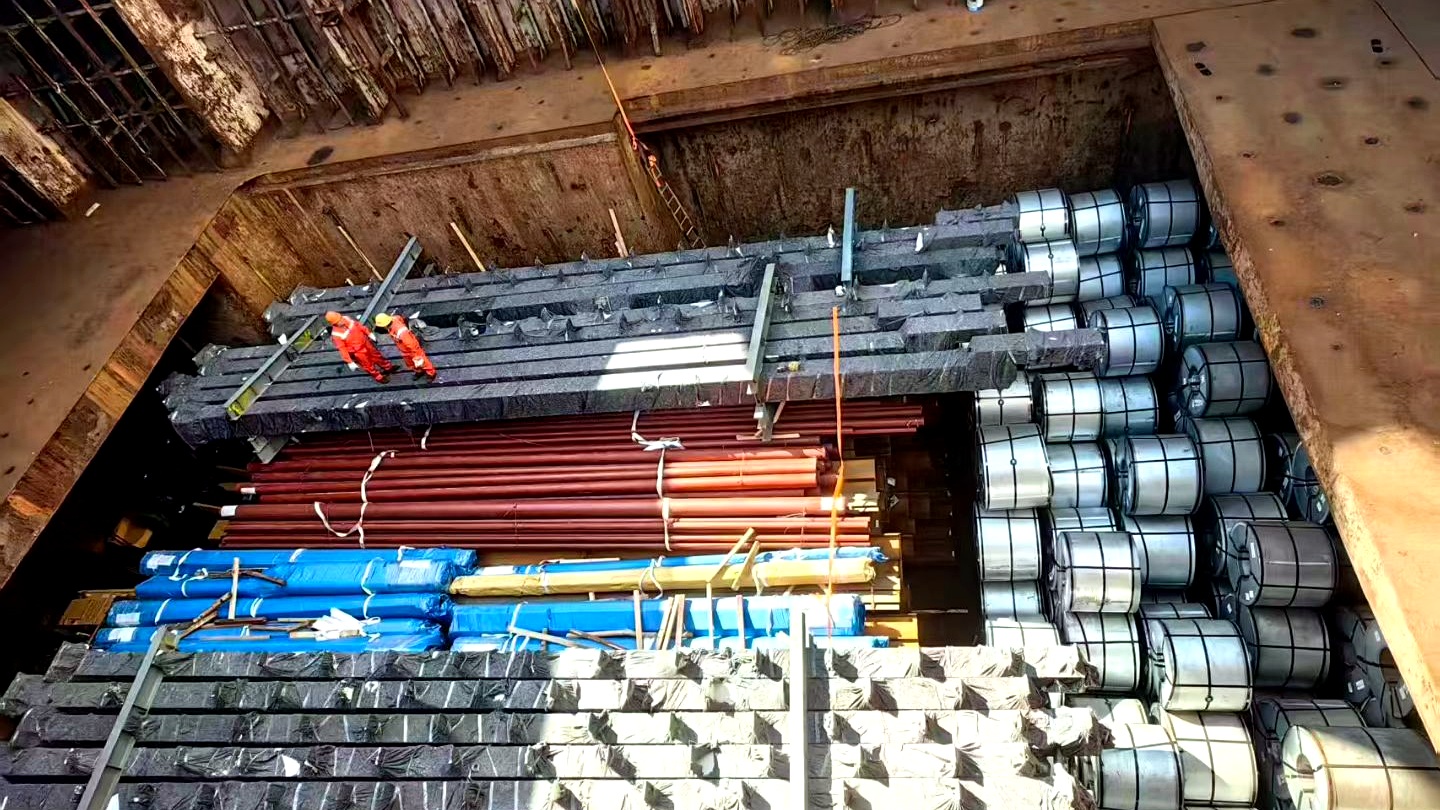
The same check applies to steel in the hold. Coils, long sections and bundled pieces are arranged together, but the supports and contact points are not interchangeable. A round coil needs anti-rolling support. A long bundle needs a stable bearing line. A protected surface may need dunnage before a sling or wire rope is brought into position.
If the photograph does not show the lifting condition, we do not treat the piece as fully ready. We ask for a new photograph, a drawing or a confirmed handling note before fixing the sequence.
The securing method changes with the shape
For oversized flat steel coils, the working method in our securing reference is cross-lashing with wire ropes to prevent movement between coils. That is not a substitute for checking the actual coil dimensions, bearing surface and vessel arrangement. It is the starting method to be tested against the real cargo.
The same principle applies to other steel:
- round cargo needs a way to stop rolling;
- bundled sections need stable dunnage and contact points;
- long pieces need a loading position that does not block the next lift;
- mixed cargo needs a sequence that avoids unnecessary re-handling.
The mistake is to write “steel cargo, standard lashing” and leave the decision until the crew is already working in the hold.
The number that matters is the cost of an unplanned re-handling
Our five-year internal review found a clear difference between batches using a standardised securing plan and batches relying on ad-hoc crew judgement: cargo damage was 0.3% in the former and 2.1% in the latter.
That is a seven-fold gap.
It does not mean that every steel shipment will produce the same result. It does show why the securing plan belongs before loading, when the cargo, vessel and stowage position can still be changed. Once a coil or bundle is deep in the hold, correction usually means another lift, another working period and another exposure to damage.
What we confirm before the cargo moves to the quay
For a Luojing steel shipment, the working sequence is:
- Reconcile the piece list with the latest packing and weight information.
- Mark the heaviest, widest and longest pieces.
- Check whether the photographs show the actual lifting and bearing condition.
- Match each cargo form with its dunnage, anti-rolling or lashing requirement.
- Build the loading order around discharge sequence and access in the hold.
- Recheck the cargo-ready date against the vessel's confirmed loading window.
- Treat any change in weight, dimensions, packing or quantity as a plan change—not a clerical correction.
The photos in this article show the two ends of the same operation: coils waiting in a warehouse, and different steel forms already arranged inside a vessel hold. The missing work is the part between them—turning piece-level data into a loading and securing plan.
That is what “ready to ship” should mean at Luojing.